
| While nanostructured materials combined with emerging nanomanufacturing processes are advancing the next generation of displays, e-paper, renewable energy, and energy storage devices, the predominant technologies have employed scaled processes on flexible substrates facilitated by roll-to-roll platforms. Recently, a group of researchers at Stanford University have taken this concept one step further by demonstrating the core materials and processes for fabrication of such devices on everyday paper. |
Reviewed by Jeff Morse, PhD., National Nanomanufacturing Network
While nanostructured materials combined with emerging nanomanufacturing processes are advancing the next generation of displays, e-paper, renewable energy, and energy storage devices, the predominant technologies have employed scaled processes on flexible substrates facilitated by roll-to-roll platforms. Recently, a group of researchers at Stanford University have taken this concept one step further by demonstrating the core materials and processes for fabrication of such devices on everyday paper. Hu et. al. from Yi Cui’s research group in Stanford’s Materials Science and Engineering Department reported their investigation of of single walled carbon nanotubes (SWCNTs) dispersed in inks to create high conductivity electrodes on regular paper.
| Additional News Coverage |
Conductive thin films incorporating solution-based nanostructure dispersions have gained significant attention as a means to replace conventional thin film conductors with a lower-cost, higher-performance material useful for large area applications such as flexible displays, transparent electrodes for solar photovoltaics, or current collectors for batteries, supercapacitors, and fuel cells. Previous investigations of CNT thin films to form electrodes on rigid or flexible surfaces have combined nanomaterials with surfactants, providing well-dispersed nanostructures in solvent ink solutions that can be cast over a substrate. The main focus of those investigations has been on solvent evaporation and surfactant removal addressing issues of rheology and surface/film binding. A key problem has been achieving the right balance of surfactant and polymer adhesive to obtain solid adhesion with low sheet resistance in a simple, scalable process. Also, residual surfactant or binder materials leave an electrically insulating barrier between the nanostructures in the thin film thereby decreasing the conductivity.
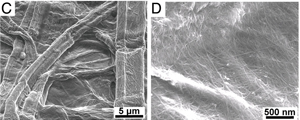
The implications of this research are far reaching and will certainly impact technologies requiring large-area conductors and current collectors. The authors describe supercapacitor and Li-ion battery designs using the paper electrode structures. Their report indicates that the highly conductive paper performance is competitive with conventional foils and electrodes in which similar chemistries are used. Furthermore, the nano-enabled conductive paper provides >20% volume reduction and will eventually provide further cost reductions due to the low cost materials and simple process requirements for implementation of this technology approach. This research certainly points to the idea that “simpler is better,” providing a new paradigm for many products exploiting the use of flexible and thin substrates.
Image from Hu L, Choi JW, Yang Y, Jeong S, LaMania F, Cui LF, and Cui Y. Highly Conductive Paper for Energy Storage Devices. PNAS Published online 7 December 2009. DOI: 10.1073/pnas.0908858106.Copyright PNAS.

This work is licensed under a Creative Commons Attribution-NonCommercial 3.0 Unported.


