
| A key remaining challenge for the preparation of CNT-based transparent electrodes suitable for flexible substrates is to optimize the sheet resistance and transparency of CNT films for specific implementations. Scardacci et. al. investigate the transmittance and sheet resistance tradeoff for CNT films spray-coated onto polyethylene terephtalate (PET) substrates and report a scalable method for the control of these parameters for transparent electrode applications. |
Reviewed by Jeff Morse, Ph.D, National Nanomanufacturing Network
Transparent electrodes suitable for flexible substrates are a critical element of numerous technologies including solar photovoltaics (PV), displays, and organic light emitting diodes. At present indium tin oxide (ITO) is the predominant material used for these applications. The drawback of ITO is its limited supply, which has driven up cost in recent years, along with the brittleness of the materials system that makes it problematic for flexible applications. As such, a significant amount of research has focused on identifying alternative materials to replace ITO. Carbon nanotubes (CNTs) have drawn a lot of attention due to their high electronic conductivity, low cost, and suitability to form solvent ink dispersions that can be spin or spray coated.
The varying levels of conductivity for CNT films has been mainly attributed to the solvent formulations and subsequent acid washing chemistries that can either leave a residue on the CNTs, which acts as a barrier to electron conduction, or damage the CNTs themselves. Progress in this area has resulted in reductions in sheet resistance of films formed from suitable dispersions to the point where CNT electrodes are now competitive for next generation products on flexible substrates. The key remaining challenge is to optimize the sheet resistance and transparency of CNT films for specific implementations. The rule of thumb for transparent electrodes is transmittance T>90% and sheet resistance Rs<100 Ω/sq.
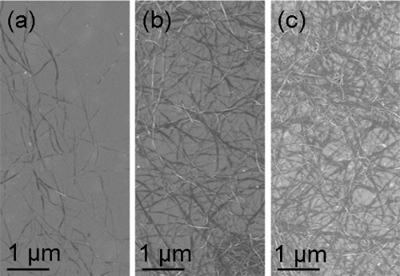
Experimental results indicated a linear dependence between Rs and T for CNT film thickness t>20 nm, which followed an analytical model developed by the authors. For films thickness t<20 nm where the CNT film forms a percolating network, the nonuniformity in local sheet resistance and transmittance is controlled by the formation CNT bundles in the 20-25 nm diameter range. In this regime it becomes difficult to predict the dependence between sheet resistance and transmittance as the performance of the film degrades. In general this range of film thickness has less importance as the resistivity is excessively large, even though transmittance T~99% is achieved. For T=90% CNT film sheet resistance Rs=400 Ω/sq was achieved using this approach. Therefore a facile, scalable method for the control of sheet resistance and transmittance for transparent electrodes formed form CNT dispersions has been reported. Further investigations may consider the impact of the substrate rinse and acid wash on resistivity, as well as explore dispersion chemistries that have less of an impact on film performance in order to meet the targeted film performance for specific applications.
Image reproduced from Scardacci V, et. al. 2010. Applied Physics Letters 97 (023114). DOI: 10.1063/1.3462317. Permission pending.

This work is licensed under a Creative Commons Attribution-NonCommercial 3.0 Unported.


