
| Neville, et. al., investigate a silicate nanoparticle fabrication process based on natural biosilication, in which specialized proteins catalyze silication at neutral pH and ambient temperature conditions to produce silicate nanostructures down to 50 nm in size. |
Reviewed by Jeff Morse, Ph.D, National Nanomanufacturing Network
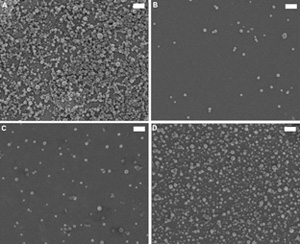
A silicate nanoparticle synthesis route that can incoprorate biological components, such as entrapped enzymes, and pre-functionalize with reactive groups, such as thiols, would find implementation in a range of surfaces and materials. Process improvements might also include simple, fast fabrication, with controlled functionalization steps. Neville, et. al., report a novel one-pot synthesis of bioactive thiol-silicate nanoparticles in Nanotechnology. The authors investigate a silicate nanoparticle fabrication process based on natural biosilication, in which specialized proteins catalyze silication at neutral pH and ambient temperature conditions to produce silicate nanostructures down to 50 nm in size.
In the work described, silicate nanoparticles pre-functionalized with free thiol groups were synthesized using a straightforward process in which the substituents were mixed at near neutral pH and ambient temperature without the use of alcohol or ammonia. These thiol-nanoparticles have the advantage that they can be readily tethered to a metal surface or metal particles, and are therefore useful in producing self-assembled systems. Furthermore, enzymatic activity can be introduced by immobilization within the nanoparticles or via surface immobilization with the reactive groups attached to the particle. A similar one-pot process was used to fabricate thiol-nanoparticles with entrapped enzymes.
Characterization and testing by the authors demonstrated that this method produced nanoparticles having free thiol groups present. The thiol-nanoparticles readily bind to gold surfaces. A sample of thiol-nanoparticles with entrapped enzymes exhibited a bimodal size distribution in which the larger size particles, having diameters in the range of 300-400 nm, contained the majority of enzymatic activity; the smaller diameter particles, 100-200 nm in diameter, significantly lower concentration of immobilized enzymes. Thus, a simple, one-pot methodology for fabrication of pre-functionalized silicate nanoparticles has been reported providing benefits for incorporation of biomolecules. The process further demonstrated that various enzymes could be immobilized on the silicate nanoparticles making this technique suitable for a range of biosensor and biocatalytic reactor applications.
Image reproduced with permission from Neville F, Pchelintsev NA, Broderick MJF, Gibson T, and Millner PA. 2009. Novel one-pot synthesis and characterization of bioactive thiol-silicate nanoparticles for biocatalytic and biosensor applications. Nanotechnology 20 (055612). DOI:10.1088/0957-4484/20/5/055612.


